
Holy Trinity
Exploring The Holy Trinity: A Journey of Charcoal, Faith, and Mysticism
In early 2025, I found myself experimenting with charcoal on a raw canvas. I was drawn to the idea of seeing how the rawness of the canvas would interact with the simplicity and impermanence of charcoal. Each time I drew a concentric circle, a little bit of charcoal dust would fall away, leaving a trace of the process behind.
I started with one circle, but it felt a bit lonely on the canvas, so I added a second. And then, as if completing a thought, I added a third. Soon, the three interlocking circles emerged as a visual meditation on the Holy Trinity. Each circle was carefully drawn with a compass, creating layers of meaning and a sense of depth.
As I worked, I found myself reflecting on how this image connected my learnings of both Christianity and Eastern mysticism. I’d been reading about the “lost years” of Jesus, a fascinating narrative of his travels through India, Nepal, and Tibet, and the possibility that his teachings might have intertwined with Eastern spiritual wisdom. This blending of ideas—of the Father, the Son, and the Holy Spirit as a divine essence within us—resonated deeply with me. Jesus spoke in parable, and It felt like a koan of a Zen teaching, something that transcended one tradition and invited a universal truth.
In the end, “The Holy Trinity” became more than just a painting. It was a reflection of my exploration of how the divine is both within and around us, a reminder that we are made in the image of something greater and that the journey of faith is about discovering that unity. This piece is a testament to the merging of traditions, the blending of teachings, and the ever-present mystery of the divine.
As I delved deeper into the meaning behind “The Holy Trinity,” I found myself reflecting on the nature of faith itself. I once heard it said that there are three kinds of faith: dead faith that only professes without practice, demonic faith that professes but acts as its own god, and saving faith that both professes and practices. In many ways, this piece became a meditation on that saving faith—the kind that doesn’t just speak but lives out its belief, merging the divine within us with the actions we take every day.
There’s a subtle, beautiful difference between belief and faith. Belief, by its nature, often feels certain. It’s tied to dogma or ideology, providing a firm ground to stand on but often carrying a thread of doubt hidden beneath that certainty. Faith, on the other hand, embraces uncertainty. It’s not about having all the answers; it’s about trust—trust in the mystical, in the divine, and in the idea that everything is ultimately working toward the benevolence within us all. I once heard it said by comedian Pete Holmes that “God is the name of the blanket we place over the mystery to give it form.”
To me, the Holy Trinity is not just a theological concept; it’s a living journey of practicing what we believe and allowing that faith—that deep trust in the face of uncertainty—to shape how we see the world. This painting, in its circles and its layers, became a way to explore that idea—faith not just spoken, but lived. It’s trust that goes beyond belief, beyond certainty, and into the very heart of the divine.
In 2025, this piece found a new home through an art show called The Bold Collab. It was a truly exciting moment when “The Holy Trinity” sold to an interior designer named Ashley Cardiel for one of her clients. Ashley is a fantastic designer, and I had the pleasure of collaborating with two incredible women from The Bold Collab: Andrea Brooks and Claire Pongonis. Andrea, another amazing interior designer, has this unique gift of bridging the world of interiors and artwork, while Claire is an incredible artist and curator in her own right.
We’ll be installing the piece for the client sometime in late January, and I couldn’t be more excited about it. As for the painting itself, it found its perfect home, and brought this whole journey full circle.
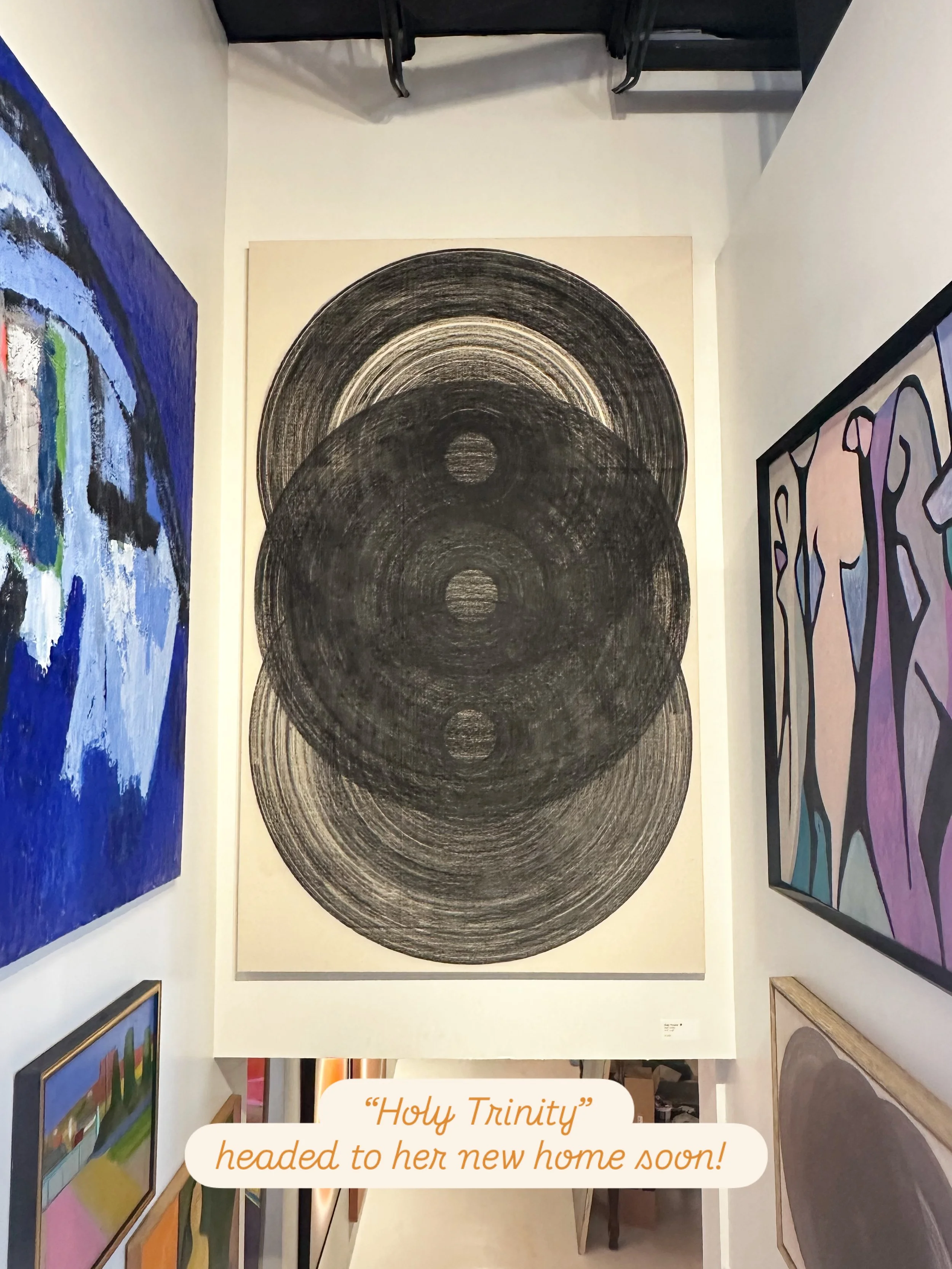
The Holy Trinity
This charcoal artwork, titled “The Holy Trinity,” is a visual meditation on the union of biblical tradition and mystic insight. Inspired by the Christian concept of the Trinity—the Father, the Son, and the Holy Spirit—the piece invites you to explore layers of divine relationship and spiritual ascent.
In this piece, three distinct circles overlap and intertwine, each formed by countless concentric rings drawn meticulously with a compass. Instead of brushstrokes, the medium of charcoal creates depth and texture, emphasizing the harmony and unity of these sacred forms. It symbolizes a journey through ascending “doors” of consciousness—from earthly existence to the realm of unconditional love and ultimately to the divine home that is always waiting for us.
In “The Holy Trinity,” the circles become vessels for ideas both seen and unseen, bridging the gap between ancient wisdom and personal spiritual experience. It’s a harmonious vision of the Creator and creation, united and whole.